
When you place a cricket bet, you’re usually betting against a big company—the bookmaker. But what if you could bet against other fans instead? What if, for a change, you could be the one acting as the bookie? This isn’t just a thought experiment; it’s the core idea behind a cricket betting exchange, a platform that fundamentally changes how online cricket betting works. It shifts the power from a central company directly into the hands of the users. What do you consider about mostbet.
Think of it like this: a traditional sportsbook is like a retail store that sets a fixed price on its goods. A betting exchange, however, works more like a stock market or eBay. Instead of a company deciding the odds and building in their profit margin, the prices are set by the users themselves—a community of fans buying and selling bets with each other. In practice, this direct peer-to-peer competition in the betting exchange vs sportsbook debate is precisely why the odds are often more favorable.
This marketplace approach unlocks a powerful new level of control. You’ll soon learn not only how to “back” a team to win, just as you always have, but also how to “lay” a team—betting that they won’t win. This simple but revolutionary concept is the first step toward finding better value and making smarter decisions. By the end of this guide, you will grasp a completely different, and potentially more profitable, way to engage with the sport you love.
Why is a Betting Exchange Different from a Regular Betting Site?
On a normal betting site, you’re always playing against ‘The House.’ The company sets the odds on a cricket match and, just like any business, builds in a profit margin for itself. You are betting against them, and this built-in advantage is how they make money over time, regardless of which team wins. This fundamental difference is the key distinction between a betting exchange and a sportsbook.
An exchange flips this model entirely. Think of it less like a shop and more like a stock market for sports. Instead of betting against a faceless company, you are placing peer-to-peer cricket wagers directly against other fans. The exchange is simply the neutral platform that connects you both, holding the money securely until the match is over. It doesn’t take a side or care who wins.
So, where do the odds come from? You and the other users create them. It’s a true marketplace where the prices are driven by supply and demand. Because you’re removing the bookmaker and their profit margin from the equation, the odds on an exchange are often better. This new setup doesn’t just let you take odds; it even allows for setting your own odds. The first step in this world is learning how to ‘back’ a team to win.
What Does it Mean to ‘Back’ a Bet on an Exchange?
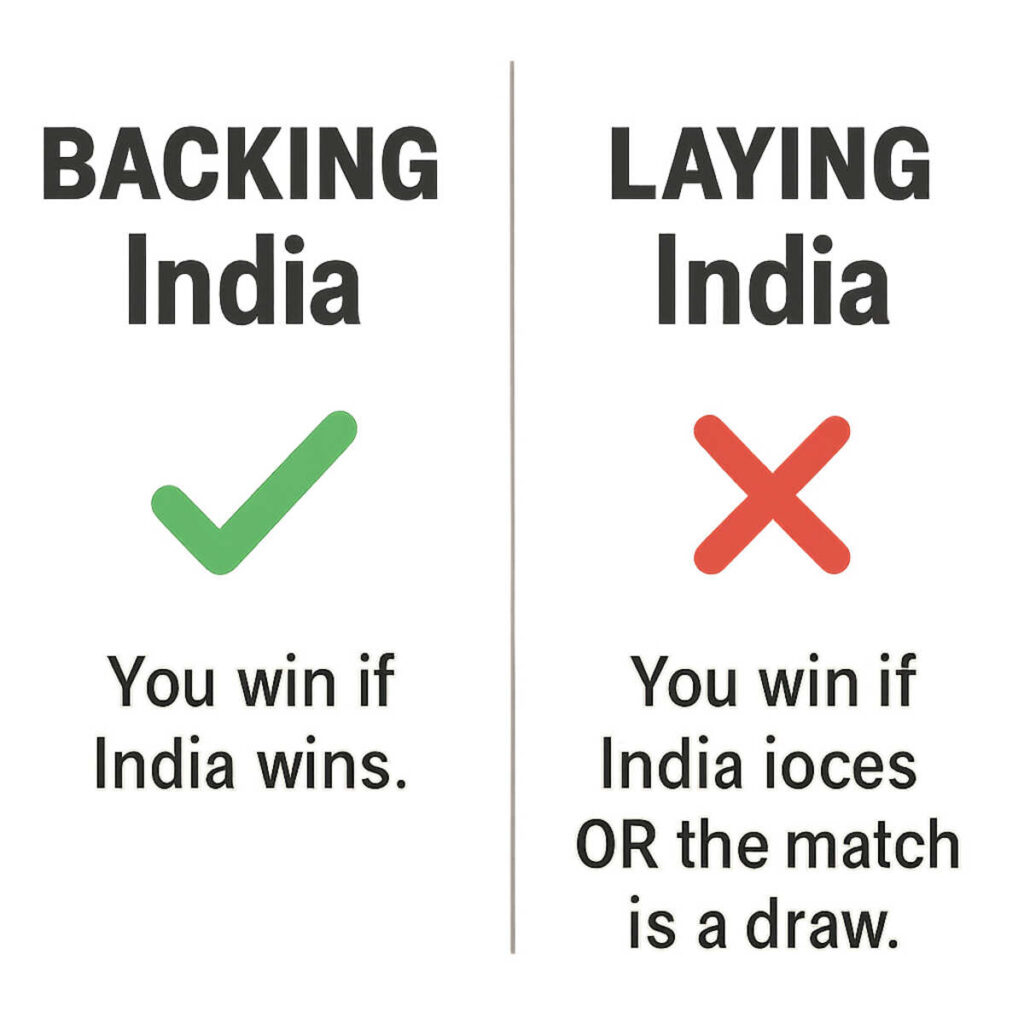
The first and most common type of bet on an exchange is called a Back Bet. This is exactly what you’re used to from traditional online cricket betting. You are simply ‘backing’ an outcome to happen, like backing India to win their next match. If they win, you win your bet. In this sense, a back bet is the most familiar action you can take, providing a straightforward entry into how an exchange works.
When you browse the exchange, you’ll see odds offered by other users. Let’s say you see odds of 3.0 for England to win. By placing a £10 ‘back’ bet on them, you are entering into a wager where a win would return £30 (£10 stake + £20 profit). These cricket exchange odds are simple; you’re just accepting a price offered by another person in the market.
Think of a back bet as being the ‘buyer’ in this peer-to-peer marketplace. You see a price you like and you take it. But for every buyer, there has to be a seller. This brings us to the other half of the equation and the real power of an exchange: learning how to ‘lay’ a bet.
The Real Power of an Exchange: How to ‘Lay’ a Bet
This is where the ‘seller’ from our marketplace analogy comes into play, and it’s the concept that makes exchanges completely different from a standard bookmaker. Instead of backing a team to win, you can place a Lay Bet. In simple terms, a lay bet is a wager that an outcome will not happen. Grasping this concept is the key to mastering how to back and lay in cricket betting exchanges.
Essentially, when you place a lay bet, you are stepping into the shoes of the bookmaker. You are accepting another user’s ‘back’ bet. If they want to bet £10 that India will win, you can be the one on the other side of that wager, effectively saying, “I’ll take that bet; I don’t think India will win.” These peer-to-peer cricket wagers are the engine of any exchange.
Let’s use a clear example. Imagine you believe England is overrated in their upcoming match. You decide to ‘lay’ England. This means you win your bet if England loses or if the match is a draw. As long as the outcome you bet against doesn’t happen, you win the other person’s stake.
Winning a lay bet is straightforward—you simply pocket the backer’s stake. But this newfound power to bet against an outcome comes with a unique kind of risk. This raises an important question: what happens if you’re wrong and the team you laid does win? This is where your ‘liability’ comes in.
What is ‘Liability’? Understanding Your Risk on a Lay Bet
When you step into the role of the bookmaker by placing a lay bet, you also take on the bookmaker’s risk. This potential payout has a specific name on an exchange: liability. Simply put, your liability is the amount of money you must pay the backer if your lay bet loses. It’s the cost of being wrong and a core concept for managing risk with cricket exchange odds.
Let’s return to our example where you laid England. Someone backed them to win with a £10 stake at odds of 3.0. If England does win, you owe that person their winnings. The calculation is straightforward: you multiply the backer’s stake by the odds, minus one. So, your liability would be £10 x (3.0 – 1) = £20. This £20 is your total risk on this bet.
This highlights the most crucial difference between backing and laying. When you back a bet, you know your risk is your stake. But when you lay a bet, your potential loss (your liability of £20) can be greater than your potential reward (the backer’s £10 stake). The exchange itself isn’t involved in this payout; it’s a contract between you and the other user. This might make you wonder: if the platform isn’t taking a risk, how does it make any money at all?
If There’s No Bookie, How Does the Exchange Make Money?
That’s the million-dollar question, and the answer reveals the core of the exchange model. Since the platform isn’t betting against you, it has no stake in whether you win or lose. Instead, it acts like a neutral marketplace—think of eBay or a stock exchange—that simply connects buyers and sellers. To fund its operations, the cricket betting exchange charges a small fee called commission. This is their entire business model.
Crucially, this commission is not charged on every bet you place. You only pay it on your net profit for a specific cricket match or event. If you have a few winning and losing bets on the same match but come out ahead overall, the exchange takes a small percentage of your total winnings. For example, if you make a net profit of £100 on a match and the commission rate is 5%, you would pay a £5 fee and keep £95. If you end up losing money on that market, you pay nothing.
This small fee, typically between 2% and 5%, is the secret behind one of the key benefits of peer-to-peer cricket wagers. Because the exchange isn’t trying to build a large profit margin into the odds like a traditional bookmaker, the odds are often more favourable for the user. It’s this structure that directly leads to the “better value” that attracts so many people to exchanges in the first place.
The ‘Better Value’ Secret: Why Exchange Odds are Often Higher
Because exchanges make money from commission, not from losing bettors, they can offer a significant advantage. A traditional bookmaker, or sportsbook, builds its profit directly into the odds it offers. Think of it as a hidden margin. For any given cricket match, they slightly shorten the odds for every possible outcome to guarantee they pay out less than they take in over the long run, regardless of who wins. This is a fundamental point for anyone comparing cricket exchange odds.
The difference becomes clear when you compare the two. Imagine a perfectly balanced T20 match between India and Pakistan, where each team has a 50/50 chance of winning. Here’s how the odds might look:
- Traditional Bookmaker:
- India to win: 1.90
- Pakistan to win: 1.90
- (The bookmaker has built in a margin of over 5%)
- Betting Exchange:
- India to win: 2.02
- Pakistan to win: 2.02
- (The market is set by users and is much closer to a ‘true’ 100% market)
Ultimately, the betting exchange vs sportsbook for cricket debate comes down to this core distinction. Because an exchange market is a peer-to-peer environment, the odds are shaped by supply and demand, not by a company trying to lock in a profit margin. This creates a fairer, more efficient marketplace that naturally settles closer to the true probability of an event. For bettors, this usually translates directly into better value and higher potential returns.
What is ‘Liquidity’ and Why Does it Matter for Your Cricket Bet?
Since you’re betting against other people on an exchange, there needs to be money on the other side for your wager to be accepted. This available pool of money is called liquidity. Essentially, it’s the total cash that other users have already offered to bet at certain odds. You can see this amount displayed directly below the odds on your screen, showing you exactly how much money is waiting to be matched for both back and lay bets.
A healthy amount of money in the market ensures your bet can be placed instantly. This is called a matched bet—a confirmed wager where your stake is immediately accepted because someone took the other side. For major online cricket betting events, like an IPL final or an Ashes Test, the liquidity is usually very high. This deep pool of money means you can confidently place a bet on a popular cricket betting exchange knowing it will be matched right away.
On the flip side, markets for smaller or less popular matches might have low liquidity. If there isn’t enough money available at your desired odds, your bet may become unmatched. It will simply wait in the system until someone comes along to accept it. In some cases, your bet might even be partially matched—meaning if you wanted to bet £10, perhaps only £4 of it was accepted. This is a crucial detail to grasp before you place your first wager.
A Step-by-Step Guide: Placing Your First Back and Lay Bet
Seeing how to back and lay in cricket betting is what makes the concepts click. The good news is that exchange websites are designed to make this process straightforward. Once you’ve navigated to a match, you’ll see the teams listed with two main boxes of odds next to each name—one for backing and one for laying.
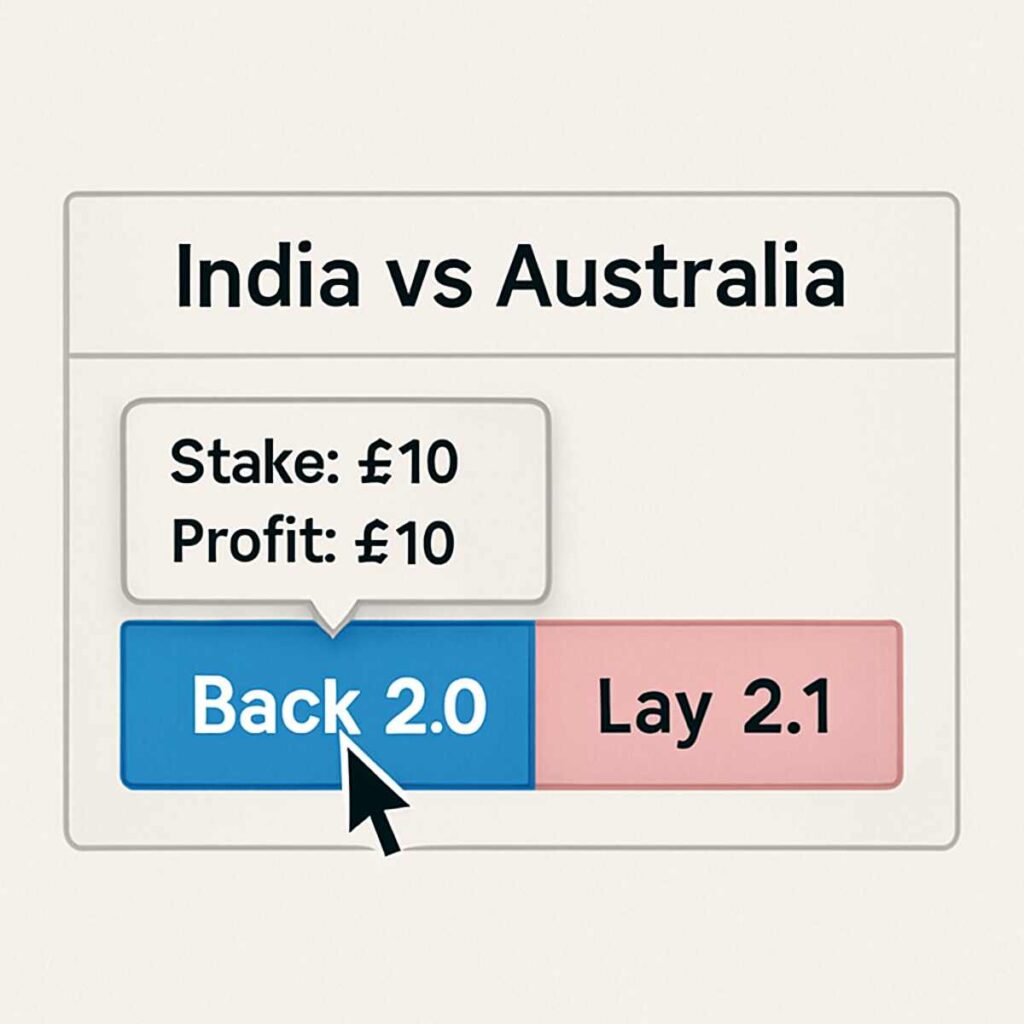
Let’s walk through an example for a live cricket betting match: India vs. Australia. The process is simple and gives you full transparency before you commit any money.
- Select the Match: Find and click on the “India vs. Australia” market.
- Choose Your Bet: The odds for each team are typically shown in colour-coded boxes. To bet on India to win, you click the blue Back box. To bet against India winning, you click the pink Lay box.
- Enter Your Stake: After you click, a bet slip appears. Here, you enter your stake—for instance, £10.
- Confirm Your Bet: This is the most important step. Before you click the final confirmation button, the bet slip will clearly show you your potential profit if you win and, crucially for a lay bet, your total liability if you lose.
This “preview” of your potential profit or liability is a fantastic safety net. It removes any guesswork and ensures you know exactly what you’re risking before your bet is placed. With this control, some bettors even use the exchange to change their position mid-match, a technique often called hedging.
How Exchanges Let You ‘Hedge’ a Bet to Lock In a Profit
That ability to bet both for and against an outcome opens up a powerful strategy known as hedging, or trading. It’s a way to react to events as they unfold during a match to either guarantee a profit or cut your losses, a flexibility rarely found with traditional bookmakers. It turns a simple “win or lose” bet into something with far more control.
Imagine you placed a £10 back bet on Australia to win at high odds of 4.0 before the match started. If they win, you stand to make a £30 profit. Midway through the game, Australia performs exceptionally well, and their odds to win plummet to just 2.0. Your pre-match bet is now looking very strong.
This is where the magic of the exchange comes in. With Australia now the firm favourite, you can place a lay bet against them at these new, lower odds. By placing a specific lay bet, you can create a situation where you make a smaller, guaranteed profit regardless of whether Australia goes on to win or lose the match. You’ve traded your high-risk, high-reward position for a guaranteed win.
Of course, this also works in reverse. If your initial bet starts to look shaky, you can often place an opposing bet to minimize your potential loss. This dynamic ability to hedge is what makes exchanges feel more like a live marketplace. The key is to understand why those odds move so dramatically during a live game.
A Glimpse into Live Trading: Why Odds Change During a Match
Unlike the fixed odds you get from a traditional bookie, exchange prices are alive. They behave like a real-time stock market for the match, where the “stock price” is a team’s chance of winning. Because the odds are set by thousands of fellow fans backing and laying outcomes, they constantly shift to reflect the collective opinion of the market. This creates a dynamic environment where the price of a bet is a live indicator of the game’s momentum—the core of any in-play cricket trading guide.
Think about the key moments in a T20 match. When a star batsman hits two consecutive sixes, confidence in their team surges, and more people will want to back them. This increased demand causes their odds to drop. Conversely, if a crucial wicket falls, belief wavers. Bettors may rush to lay that team, anticipating a collapse, which pushes their odds higher. Even external factors like a sudden rain delay can dramatically alter calculations and cause live cricket betting odds to swing as the market digests the new information.
This constant fluctuation is the entire basis of what is known as in-play trading. Traders aren’t just placing a single bet and hoping for the best; they are reacting to these price movements, often placing multiple back and lay bets throughout the game to capitalise on the changing tides. Recognizing that on-field events directly influence the prices on the exchange is the first major step from being a simple punter to thinking like a trader.
Match Odds vs. Fancy Markets: Where Should a Beginner Start?
When you first open a cricket betting exchange for a match, the sheer number of options can feel overwhelming. The most important one to focus on, however, is the Match Odds market. This is the simple, foundational bet that asks the main question: Who will win? Because it’s the most popular, it has the most activity, making it easier to get your back and lay bets matched. It’s the central hub of betting for any given game.
Beyond the main event, you’ll discover a wide variety of Fancy Markets. These are more specific, speculative bets on smaller incidents within the game. Think of predictions like the total number of boundaries, the runs scored in the first six overs, or even a batsman’s individual score. While they add an extra layer of excitement, they are often less predictable and can be much riskier for newcomers.
As you’re starting out, a good practice is to stick to the main Match Odds market. This approach allows you to get comfortable with the core mechanics of backing and laying in a clearer, more stable environment. Mastering the fundamentals here is crucial before exploring the complexities of match odds vs fancy market trading. Before placing any bet, it’s vital to address a key question: Is using a cricket betting exchange legal and safe?
Is Using a Cricket Betting Exchange Legal and Safe?
Before you even think about placing a bet, the most important question is a legal one. The rules for online cricket betting vary dramatically from one country to another, and even between states or provinces. Therefore, determining if using a cricket exchange is legal in your specific location is the essential first step you must take.
Once you’ve confirmed its legality, your next focus must be on safety. This is where licensing comes in. A trustworthy cricket betting exchange will be licensed and regulated by a respected governing body, like the UK Gambling Commission or the Malta Gaming Authority. Think of this license as a guarantee that the company is held to strict standards. It means a government-approved watchdog is making sure the platform operates fairly, securely, and transparently.
These regulations provide crucial protections that you simply won’t find on an unlicensed site. For one, licensed exchanges are required to keep player funds in separate, protected accounts, so your money is safe. They also ensure the platform operates fairly and provide tools to help you gamble responsibly, such as setting deposit limits. Choosing a licensed operator isn’t just a good idea—it’s the only way to ensure a secure betting environment.
With that foundation of safety established, it’s time to weigh the key pros and cons to decide if an exchange is right for you.
The Key Pros and Cons: Is an Exchange Right for You?
Now that the workings of a cricket betting exchange are clear, the big question is whether it’s a better fit for you than a traditional bookmaker. The answer isn’t the same for everyone. It comes down to a trade-off between the greater control and value an exchange can offer versus the simplicity of a standard betting site.
To help you decide, here’s a straightforward comparison of the main advantages and disadvantages.
| The Advantages (Pros) | The Disadvantages (Cons) | | ————————————————————————————- | ————————————————————————————- | | Often Better Odds
Because you bet against other users, the bookmaker’s profit margin is removed. | More Complex to Learn
The concepts of laying and liability take time to fully grasp. | | Ability to Lay Bets
You have the unique option to bet on something not to happen. | Risk of Liability
When you lay a bet, you can lose more than the other person’s stake. | | No Account Restrictions
Winning players aren’t penalized or limited, as the exchange isn’t betting against you. | Commission on Winnings
The platform takes a small percentage of your net profit as a fee. | | More Flexibility
The peer-to-peer format gives you more control over the odds you want to take. | Unmatched Bets
Your bet only becomes active if another user agrees to take the other side. |
Ultimately, choosing between a sportsbook and an exchange depends on what kind of bettor you are. If you value simplicity and just want to quickly back a team to win, a traditional bookmaker is probably your best bet. However, if you’re intrigued by the idea of having more control, enjoy the challenge of acting as the bookie, and are willing to learn the ropes, a cricket betting exchange opens up a whole new world of strategic possibilities.
Your Next Steps: From Understanding to Confidently Exploring
Before today, the world of online cricket betting may have seemed like a simple, one-way street: you against the house. Now, you see it as a dynamic, two-way marketplace. You’ve moved beyond just picking a winner and can see the engine that powers a true cricket betting exchange, where every fan’s opinion has a place and a price.
This new perspective is built on key principles: you are betting against other fans, not a company; you have the power to not only back an outcome to happen but to lay it to fail; and you know that your risk on a lay bet is your liability. By removing the traditional bookmaker, this peer-to-peer model creates the potential for better value.
Your best first step is to build confidence without risk. Open an exchange during a live match and simply watch. Observe how the market moves. By seeing the back and lay odds in action, you will cement your knowledge and begin to see the game in a completely new light.