
You plug in the space heater on a cold morning, and suddenly the entire living room goes completely dark. Panic sets in as you hear a faint, unsettling buzz from the hallway wall, prompting your thumbs to fly across your phone screen to type “electrician near me.” That immediate spike of anxiety is entirely natural, because your home is loudly signaling that its electrical system is dangerously overwhelmed. Best way to find the electrician near me.
Consumer behavior experts note that this exact moment of urgency is where the most costly hiring mistakes occur. Desperate to restore power and protect their families, homeowners frequently stumble into the “Proximal Trap.” This psychological pitfall happens when you prioritize a local electrician based solely on how close their office is, rather than verifying if they actually have the training to safely diagnose the hidden wiring behind your walls.
Geographic proximity should never outweigh professional competence, especially when dealing with the hazardous currents flowing through your home. To protect your property, you must shift your mindset toward a credential-first searching strategy. According to state licensing boards, taking a few extra minutes to confirm an expert’s insurance and qualifications before booking emergency electrical repair services is the only proven way to prevent a sloppy, temporary fix from turning into a devastating house fire.
Regaining control over this stressful situation requires a simple shift in strategy rather than a deep knowledge of electrical theory. Mastering a clear, 5-step vetting process gives you a reliable roadmap to filter out unqualified handymen, evaluate credentials, interpret online reviews, and secure lasting peace of mind for your family.
Is It an Emergency? How to Tell When You Need 24/7 Assistance vs. a Scheduled Visit
When a breaker abruptly trips and plunges your room into darkness, you might agonize over whether to call an emergency electrician at midnight. Paying premium weekend rates for a simple overloaded circuit is frustrating, but ignoring a genuine hidden hazard can be catastrophic. The secret to making the right call—and keeping your money in your pocket—is using the “Heat-Smell-Sound” safety test to identify minor issues that can safely wait for a scheduled Monday visit.
However, other symptoms indicate your home’s wiring is actively failing and requires 24/7 emergency electrical assistance to prevent a fire. When troubleshooting flickering lights in house wiring or checking a dead plug, call for immediate help if you encounter any of these five non-negotiable red flags:
- A persistent acrid, melting plastic, or “fishy” burning smell.
- “Load-induced buzzing,” a serious warning sign where your panel sounds like vibrating bees when heavy appliances run.
- Any leaks, flooding, or direct water contact near live wires.
- “Thermal outlet failure,” meaning a wall plate is smoking, scorched, or feels uncomfortably warm to the touch.
- Severe pulsing or dimming overhead lights specifically when heat-producing devices turn on.
Before the technician arrives to investigate those hazards, your only job is to stop the flow of power by walking to your main electrical panel and firmly flipping the large top breaker to the “Off” position. Once the current is severed and the immediate danger is paused, you can focus on finding the right expert to permanently solve the problem.
The Paperwork of Protection: Why ‘Licensed and Insured’ Is Your Only Real Warranty
Handing your panel over to a friendly handyman might seem like a smart way to save a few dollars, but it opens a dangerous “liability gap” in your home’s protection. If an uncertified worker accidentally sparks a fire while installing a new circuit, your homeowners insurance company will naturally investigate the cause. Once they discover the repair was performed without proper credentials, they can legally deny your claim, leaving you completely responsible for the devastating costs. This hidden financial risk is exactly why hiring licensed and insured contractors is your true first line of defense against disaster.
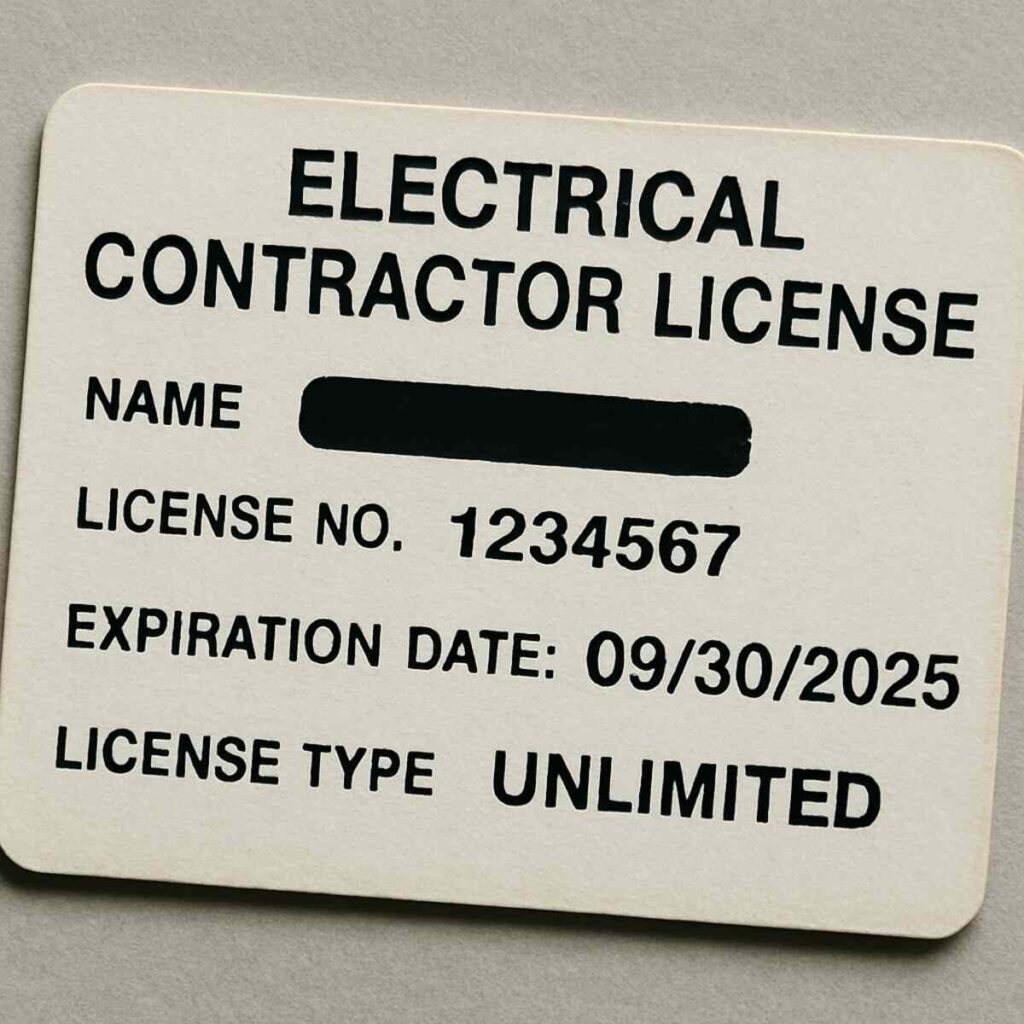
Not every official-looking document guarantees competence, so you must carefully distinguish between a basic business registration and an actual technical licensure. A generic business permit simply means a company pays local taxes, whereas a technical electrical license proves the worker passed rigorous state-level safety exams. Only this specialized credential grants them “permit-pulling authority,” which is the legal right to file for municipal permits and schedule mandatory safety inspections for your project. When you are hiring a licensed residential electrician, you are paying for this authority, ensuring third-party city inspectors will independently verify the repair meets modern fire codes.
Smart homeowners never just trust the glossy logo on a service truck; instead, they verify these credentials independently using official state database portals. Figuring out how to find reputable local electrical contractors requires asking for the technician’s specific license number and typing it into your local licensing board’s website to confirm its active, insured status. Even after you confirm a company’s legal standing, the technician who arrives at your front door might not hold the exact same qualifications as the business owner.
Master vs. Journeyman: Who Is Actually Doing the Work in Your Home?
When you hire reputable local electrical contractors, the owner is rarely the person who knocks on your door. This reality highlights the core master electrician vs journeyman difference: the trade operates on a strict, tiered system. You might receive a quote from a Master, but a Journeyman will likely be the one replacing your flickering kitchen lights. Knowing exactly who is touching your home’s wiring ensures you get the safe expertise you are paying for.
This hierarchy protects your family from underqualified work. Here is how the levels break down regarding training, testing, and legal responsibilities:
- Apprentice: The trainee. They must accumulate thousands of strictly supervised hours under a higher-ranking technician and cannot legally work alone on your system.
- Journeyman: The daily professional. They have passed rigorous state exams, completed their supervised hours requirements, and are fully licensed to work independently on standard home repairs.
- Master: The system architect. They have passed advanced code exams, hold the authority to pull municipal permits, and bear ultimate legal responsibility for the project.
Because of these vast differences in capability and training, Master electricians naturally command significantly higher hourly rates. Fortunately, many regions offer reciprocal licensing, meaning a Master’s credential in one state is legally recognized in a neighboring one, expanding your options when choosing a local electrician. Always ask the dispatcher for the specific credentials of the technician being sent to your house so you aren’t paying Master prices for Apprentice labor. Skipping this vital vetting step risks hidden financial dangers when it comes time to pay the invoice.
The High Cost of the Low Bid: Why ‘Average’ Rewiring Costs Range from $4,000 to $15,000
Receiving an estimate for major electrical work often brings instant sticker shock. The average cost of home rewiring projects usually lands anywhere from $4,000 to $15,000, leaving many homeowners wondering if they are being overcharged. This drastic range isn’t a matter of contractors guessing. When an expert evaluates your rooms, they calculate the exact effort required to safely build new, invisible power paths behind your drywall.
Your home’s physical layout dictates a massive portion of the final price tag through accessibility and what the industry calls linear foot wiring costs. This simply measures the physical distance new cables must travel from your power source to every plug. If your house has an open attic, routing these cables is fast. However, if the technician must cut through finished plaster walls and navigate around plumbing pipes, labor hours multiply quickly, driving up the invoice even for smaller properties.
Beyond the walls themselves, daily appliance usage and raw material prices heavily influence the bottom line. Modern homes require higher circuit density, meaning more dedicated wires are needed to handle heavy power traffic from air fryers and space heaters safely. Because these safety cables rely on global metal markets, sudden copper market fluctuations can unexpectedly shift your final quote. Prioritizing hiring a licensed residential electrician ensures an accurate, upfront assessment of these needs, helping you avoid frustrating “scope creep” where extra costs magically appear halfway through the job.
Beware the bargain-basement quote, as it frequently indicates a worker is cutting dangerous safety corners or skipping mandatory municipal permits. A cheap estimate might also conveniently leave out necessary foundational improvements that a reputable professional would insist on upfront, such as electrical panel upgrades that guarantee your newly run wires have a stable power source. Pushing new, high-capacity wiring into an outdated, overworked power center is a recipe for tripped breakers or worse.
The ‘Brain’ of Your Home: When to Invest in a Panel Upgrade
Every time you plug in an appliance, your circuit breaker panel—the gray metal box in your garage or basement—must decide if your home can safely handle the demand. Think of this box as your home’s central nervous system, limited by its “amperage capacity,” which is the total volume of electrical current it can process at one time. Older homes generally feature 60-amp or 100-amp service, which was plenty for basic lighting and twentieth-century appliances. However, adding heavy-duty modern conveniences like electric vehicle (EV) chargers or efficient heat pumps requires a panel “heavy-up” to a modern 200-amp system, ensuring you aren’t forcing massive power traffic through an outdated bottleneck.
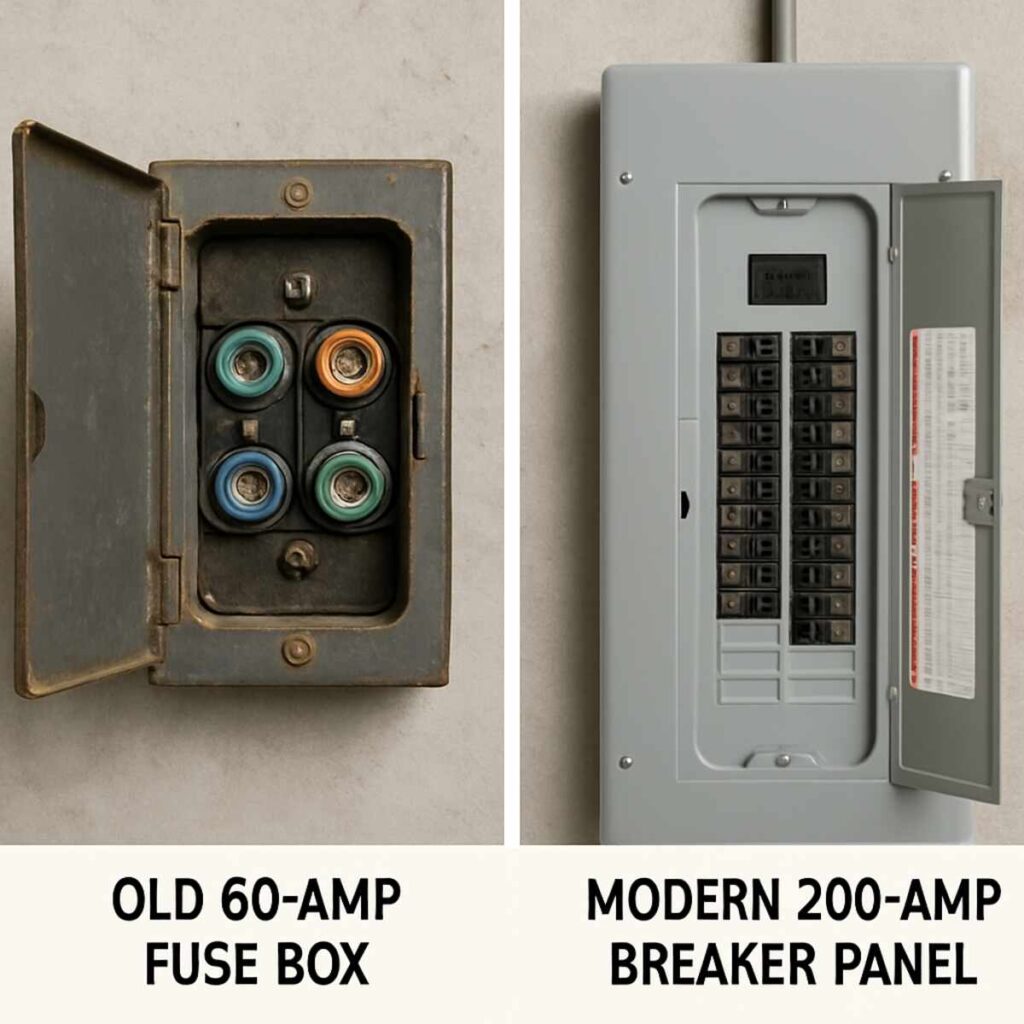
Visualizing this leap in technology helps explain why older hardware struggles to keep up with modern demands. Behind that metal door, invisible dangers like bus bar corrosion—where the thick metal strips distributing power begin to pit and degrade—can silently compromise your safety. Even without opening the cover, your home will warn you when it is experiencing internal breaker fatigue. You should actively look into signs your home needs a safety inspection if you notice these daily red flags:
- Circuit breakers that feel noticeably “warm” to the touch.
- Frequent tripping when running a microwave and toaster simultaneously.
- A heavy reliance on power strips to compensate for inadequate wall outlets.
Modernizing an exhausted system delivers immediate electrical panel upgrade benefits, most notably profound peace of mind. A licensed professional ensures your new installation achieves strict National Electrical Code compliance, permanently reducing fire hazards. Once your home’s core power center is stable, you can confidently secure the individual outlets you interact with daily.
The Invisible Safety Net: Understanding GFCI and AFCI Protection
Have you ever wondered why the outlets near your bathroom sink have little “Test” and “Reset” buttons? These are Ground Fault Circuit Interrupters (GFCIs), acting as high-speed sensors that monitor power leaving the wall and returning from your device. If a GFCI detects even five tiny milliamps of leakage—meaning electricity is escaping its intended path into water or a person—it cuts the power in milliseconds. Because water drastically increases shock risks, strict National Electrical Code compliance mandates these specialized devices in kitchens, bathrooms, laundry areas, and garages.
While GFCIs protect you from shocks, Arc Fault Circuit Interrupters (AFCIs) protect your home’s structure from hidden fires. Inside your walls, a damaged wire or a loose plug connection can create a tiny spark known as an arc-fault. Standard breakers might ignore this spark, but an AFCI specifically listens for that dangerous crackling signature and shuts down the circuit before surrounding wood ignites. Homeowners sometimes experience frustrating “nuisance tripping” with these sensitive devices, but distinguishing between a simple overloaded circuit and a genuine fault helps professionals pinpoint real hazards.
Keeping this safety net active requires just a moment each month to press those test buttons, verifying the internal mechanisms haven’t frozen. If a button fails to “click” off or refuses to reset, consulting a professional GFCI outlet replacement guide will strongly advise hiring a licensed expert rather than risking a DIY swap. Localized shock and fire risks must be neutralized before expanding your focus to whole-home protection.
Whole-Home Surge Protection: Guarding Your $5,000 in Electronics for $500
Every modern appliance in your kitchen secretly houses a delicate computer. Unfortunately, these tiny brains are constantly bombarded by transient voltage surges—brief, invisible power spikes often caused simply by your own air conditioner kicking on. While a basic $15 power strip acts merely as a surge suppressor that absorbs small hits until it quietly burns out, a true whole-home protector acts like a heavy-duty bouncer stopping dangerous electrical traffic at the source.
Safeguarding these modern investments requires a comprehensive 3-tier protection strategy:
- Utility pole protection: The grid’s initial barrier against massive lightning strikes.
- Panel-mount surges: The primary shield installed directly inside your breaker box.
- Point-of-use strips: The final local defense for sensitive electronics. When comparing these defenses, the critical metric is the “clamping voltage,” which simply means the precise threshold where the device wakes up to block excess power. Properly integrating this layered defense through professional residential surge protection installation can extend the lifespan of your smart appliances by up to 20%.
Finding suddenly dead microwave control boards or constantly resetting digital clocks are major signs your home needs a safety inspection before more permanent damage occurs. Adding this security layer to guard against everyday micro-surges is one of the most cost-effective electrical panel upgrade benefits available today.
The 7 Essential Questions to Ask Before Signing an Electrical Contract
When you finally decide to upgrade your system, the conversation shifts from protecting your electronics to protecting your legal standing. Figuring out how to find reputable local electrical contractors means knowing exactly how to read their paperwork. The most common trap homeowners fall into is confusing a loose “estimate” (a rough guess that can legally increase) with a “fixed-price quote” (a guaranteed final bill). Furthermore, hiring licensed and insured contractors is non-negotiable; without proper coverage, an injured worker or an accidental property fire instantly becomes your personal financial burden.
To separate true professionals from unverified handymen, use these “Magnificent 7” questions to guide your conversation when wondering what to ask an electrician before hiring:
- Are you pulling the local permit, or are you asking me to do it?
- Is this document a fixed-price quote or just an estimate?
- Do you practice material markup transparency so I know what the raw parts actually cost versus your fee?
- Does your warranty explicitly cover both the replacement parts and the labor?
- Can you provide physical proof of your current liability insurance?
- Will a licensed electrician be on-site doing the work, or just an apprentice?
- What are your specific cleanup expectations once the drywall is cut and the wires are run?
That first question regarding permits is actually your ultimate legal shield. If a contractor asks you to pull a homeowner’s permit, they are shifting the permit liability directly onto your shoulders. This means if the work fails or causes damage, the city legally views you as the responsible general contractor. Reputable professionals always pull their own permits because it guarantees a third-party city inspection of their work.
Code Compliance: Why the ‘National Electrical Code’ (NEC) Is Your Best Friend
That city inspector who approves your permit isn’t making up arbitrary rules; they are verifying National Electrical Code compliance. Think of the NEC as the ultimate safety playbook for your house, updated on a strict three-year cycle to keep pace with how heavily we rely on electricity today. Because modern homes handle massive electrical loads—requiring everything from high-draw kitchen appliances to residential surge protection installation—these regular code updates ensure your system won’t become an overwhelmed fire hazard. Living with severely outdated wiring isn’t just physically risky; it can actually give insurance companies a legal loophole to deny coverage if an emergency occurs.
When you eventually sell your property, ignoring these evolving standards often creates expensive nightmares at the closing table. Unpermitted handyman fixes and botched weekend wire-jobs frequently result in “escrow-stopper violations”—hidden dangers like ungrounded bathroom outlets or overcrowded breaker boxes that bring real estate deals to a screeching halt. Buyers’ inspectors are explicitly trained to spot these amateur mistakes immediately. Untangling and repairing these specific code violations under the pressure of a ticking closing clock will almost always cost you double compared to doing it right the first time.
Proactive homeowners should learn the signs your home needs a safety inspection long before putting a listing sign in the front yard. Flickering lights, warm outlets, or constantly tripping breakers are your home’s physical warnings that its wiring is struggling to meet modern NEC standards. Hiring a licensed electrician to evaluate your system guarantees you won’t be caught off-guard by non-compliant setups.
DIY vs. Professional: The ‘Death Zone’ Projects You Should Never Touch
There is a distinct line between being a handy homeowner and creating a dangerous liability. While watching an online video might give you the confidence to tackle basic drywall repairs, the stakes change entirely when dealing with live voltage. The debate of DIY electrical work vs hiring a professional usually ends the moment you realize a single loose connection can silently burn down a house.
To keep your family safe, evaluate potential projects using a strict traffic-light framework:
- Green: Swapping out a dead lightbulb or resetting a tripped breaker.
- Yellow: Replacing a basic dimmer switch—proceed only if you know exactly how to turn off the circuit breaker and verify the power is completely dead.
- Red: Opening the panel cover, adding new circuits, or touching the main service line. When facing a “red” task, you must hire a local electrician.
Hidden behind your walls, amateur mistakes quietly escalate into critical failures. Taking shortcuts like poorly twisting a wire nut or “back-stabbing” (pushing wires directly into the rear holes of an outlet) creates microscopic gaps. Electricity struggles to jump these loose connections, generating friction and heat. Over months, this causes thermal runaway—the copper heats up, the plastic insulation melts, and an electrical fire starts long before you ever consider calling for emergency electrical repair services to fix a dead plug.
Improper safety routing is another silent killer that traps well-meaning DIYers. Think of a ground wire as an emergency spillway; if a short circuit happens, the rogue power rushes safely into the earth. However, amateur splices often create high-impedance grounding, meaning the electrical escape route is severely choked off. When the surge can’t flow easily through the intended wire, it actively looks for the next best path—which might be the person touching the faulty toaster. Recognizing these life-threatening boundaries protects both your property and your life.
You no longer have to stare at a flickering kitchen light or a tripped breaker with a sense of dread. Before, searching for an “electrician near me” felt like throwing darts in the dark, hoping you wouldn’t overpay or compromise your family’s safety. Now, you hold the tools of an informed consumer. You understand the difference between a quick-fix handyman and a licensed professional, and you know exactly what questions to ask before anyone touches your home’s wiring.
It is time to put this knowledge to work. You can execute a reliable three-step vetting process—checking state licenses, reading verified reviews, and confirming insurance—in under an hour. When you need to know how to find reputable local electrical contractors, this simple logic protects your wallet and your property. As you hire a local electrician, start keeping a “Home Electrical Log.” Documenting every repair, upgrade, and permit not only gives you peace of mind today but significantly boosts your home’s resale value tomorrow.
Once your chosen professional completes the job, your role shifts from hiring to verifying. Follow this 24-hour post-hire checklist to ensure the work meets your new standards:
- Verify the cleanup: Ensure no wire scraps, drywall dust, or old parts are left behind in your living space.
- Test the new circuits: Plug a daily appliance (like a lamp or vacuum) into the repaired outlets to confirm everything works smoothly.
- File the permit certificate: Place all finalized municipal permits and warranty paperwork directly into your Home Electrical Log for safe keeping.
You have transformed a stressful home maintenance chore into a confident, empowered decision. The electrical panel in your garage is no longer a mysterious gray box to fear, but a manageable system you know how to maintain safely. The next time your home alerts you to an electrical need, you will not panic. You will simply pull out your checklist, make a smart hire, and sleep soundly knowing your home is in safe hands.