










Ever see those grids of colored dots online and feel like you’re missing out on a secret? It looks like a complex code-breaking challenge for geniuses, but the truth is much simpler. That puzzle is an online mastermind game, and its biggest secret is that anyone can learn to play it in the next five minutes. It’s less about being a genius and more about being a detective. Read the Best info about daftar arjuna189.
If you enjoy the simple satisfaction of solving a daily Wordle, you’ll immediately understand the appeal. While there’s a difference between Mastermind vs Wordle, the core feeling is the same: you make a guess, you analyze the clues the game gives you back, and you use that information to make your next guess even smarter. As millions of puzzle fans have discovered, this simple loop is incredibly addictive.
At its heart, the goal of logic games like Code Breaker is straightforward: you have a limited number of chances to figure out a hidden sequence of colors. The game gives you hints after each attempt, telling you how close you were. This guide will walk you through exactly what those hints mean and how to use them to your advantage—no special skills required.
What’s the Goal? How to Think Like a Code-Breaker
This is a simple code-breaking game brought online. Your only mission is to figure out a secret combination of colors in the correct order. Think of it like trying to guess a four-digit PIN, but with colorful pegs instead of numbers. The game secretly sets this code at the beginning of each round, and you become the detective tasked with cracking it before you run out of chances.
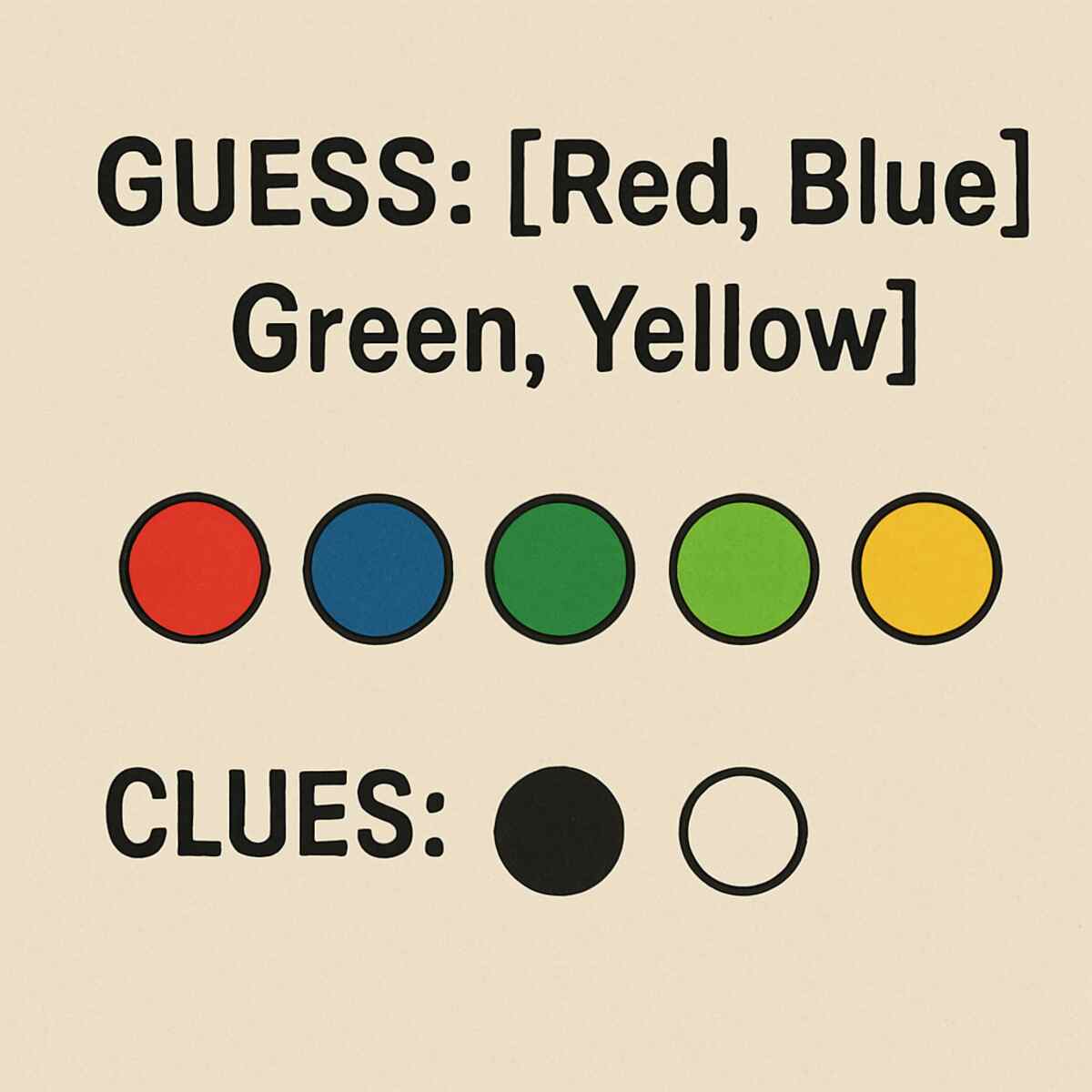
So, what does this “secret code” actually look like? In most versions of the game, the code is a row of four colored pegs. These colors are chosen from a small pool, usually of six to eight different options. For example, a hidden code might be [Red, Blue, Green, Yellow]. The challenge comes from not knowing which colors are used or what position they are in. It’s a pure logic puzzle waiting to be solved one step at a time.
You won’t have to guess it all on your first try. The game board gives you a set number of rows for your guesses, typically ten. Each row represents one turn to try a new combination. You place your colors, lock in your guess, and then the real magic of the game happens. You aren’t just guessing blindly in the dark. After each attempt, the game gives you crucial feedback that tells you just how close you were to the solution.
Understanding the Clues: Black and White Pegs
That crucial feedback is the key to cracking the code. Instead of a simple ‘yes’ or ‘no,’ the game gives you small hints that help you piece the puzzle together. These hints usually appear as little black and white circles right next to your guess row. Understanding what they mean is the single most important part of the game.
Learning how this code peg feedback works is easy because there are only two rules you need to know:
- A Black Clue: You’ve got the right color in the exact right spot. Perfect!
- A White Clue: You’ve got a right color, but it’s in the wrong spot. So close!
If you guess four colors and get no clues back, that means none of those colors are in the secret code at all, which is also very helpful information.
Here’s where the real puzzle-solving begins. Imagine you make a guess and get one Black Clue and one White Clue. The game doesn’t tell you which of your colors earned which clue! The Black Clue might be for the Red peg, but it could just as easily be for the Green peg. The White Clue means one of your other colors is correct, but needs to be moved. The clues are just a summary of your success, not a direct map.
This is what makes any online mastermind game so addictively fun. You’re not just guessing; you’re using these clues to test theories and eliminate possibilities. You might get that Black and White clue and wonder, “Does that mean my first color is right, and my third one belongs somewhere else?” Using this feedback is how you’ll make your next guess even smarter.
Making Your First Guess: A Strategic Approach
Alright, you’re facing an empty board. What’s the best way to start a new game? While a random guess can work, a simple strategy will get you much further. For your first turn, try using four completely different colors. A guess like [Red, Green, Blue, Yellow] is perfect. This approach is powerful because you’re testing four unique colors at once, which helps you gather the most information possible, no matter what clues you get back. It’s a simple trick for how to play this code breaker game effectively from the very first move.
Let’s imagine you lock in that [Red, Green, Blue, Yellow] guess. A moment later, the game gives you your feedback: one Black Clue and one White Clue. This is where the real detective work begins. You already know what these clues mean on their own, but applying them is how you learn to solve the puzzle.
So, what can you figure out from that one Black and one White clue? It confirms two crucial facts. First, one of your four colors is exactly right—the right color in the right spot. Second, another of your colors is part of the code but is currently in the wrong spot. This also tells you that the remaining two colors you guessed aren’t in the secret code at all and can be ignored.
Even with that uncertainty, look at how much you’ve learned from a single guess! In this digital version of the popular board game, you went from knowing nothing to confirming that two of the required colors are sitting right there on your board. Your next guess won’t be random; it will be a deliberate test to figure out which color to keep, which one to move, and which to replace.
Making Your Second Guess: From Clues to Action
You’re left with one Black and one White clue from your opening guess of [Red, Green, Blue, Yellow]. So, what now? This is where you get to test a theory. Since you have one color in the perfect spot, you can make an educated guess about which one it is and build your next move around that idea. Let’s pretend our Black Clue is for the Red in the first position. This is our first solid lead.
With that theory in mind, let’s build a smarter second guess. We’ll keep Red in the first spot. For the White Clue (right color, wrong spot), let’s assume it’s the Blue. We also know two of our original colors were wrong, so we’ll get rid of Green and Yellow completely. To test our theory, we can move Blue to a new position—say, the last spot—and fill the empty middle slots with two new colors we haven’t tried, like Orange and Purple. Our new guess becomes: [Red, Orange, Purple, Blue].
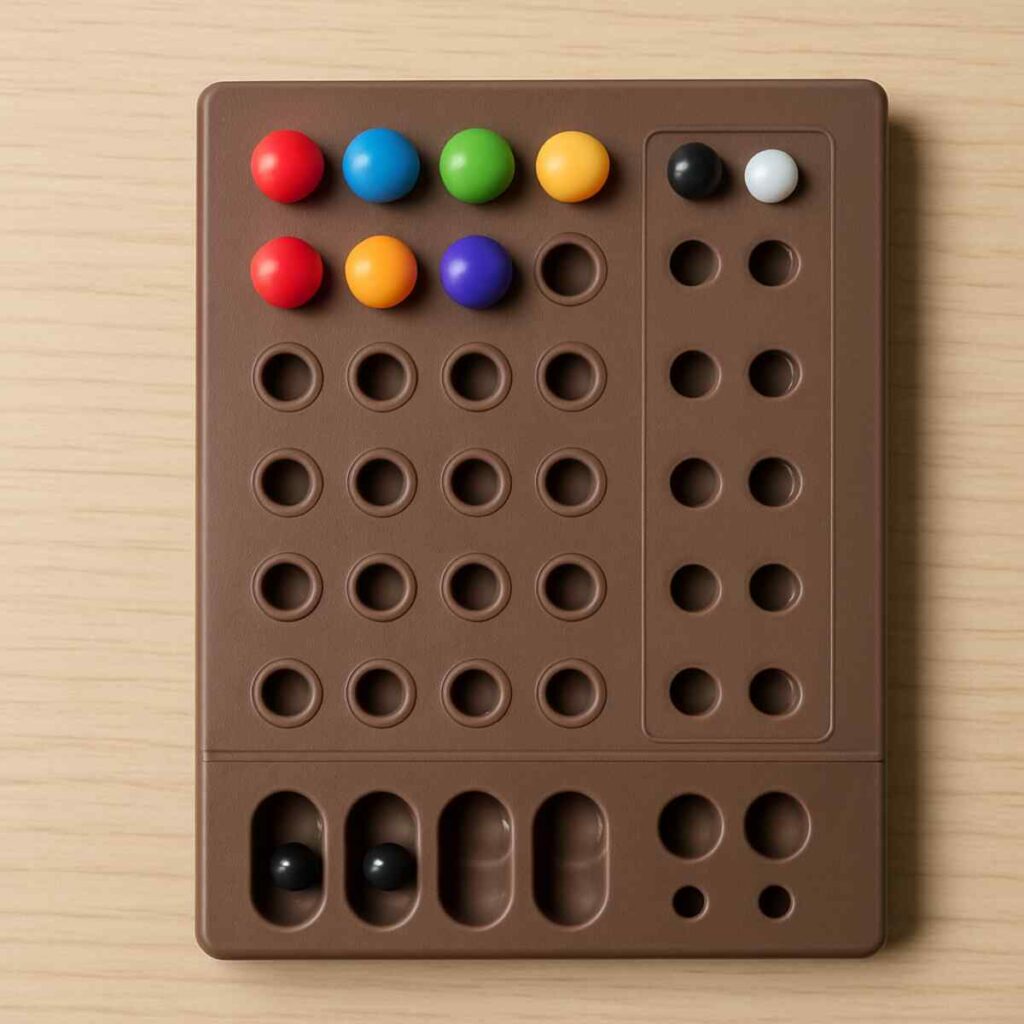
Now look at the result: two Black Clues! This is a huge breakthrough. Getting more clues tells us our theory was on the right track. Because we kept Red in the first spot and got a Black Clue again, we can be almost certain that Red is correctly placed. The second Black Clue must be from one of our other colors, and since we moved Blue to the last spot, we’ve likely found its correct position, too!
This is the core of fun logic games: you’re not just guessing randomly, you’re using previous results to eliminate possibilities and prove what works. In just one deliberate move, you went from knowing very little to likely confirming half of the entire secret code. Each guess, whether it’s right or wrong, provides valuable information that gets you closer to that “aha!” moment.
Three Core Strategies Every Player Should Know
As you saw in our walkthrough, turning clues into a better guess is the heart of the game. But you don’t have to reinvent the wheel every time. Moving beyond random guesses is easy once you have a few repeatable tactics in your playbook. These are some of the best code-breaking strategies to get you started, and they work in almost any situation.
Think of these as your go-to moves for gathering information and solving the puzzle faster. You don’t need a complex puzzle solver algorithm; you just need a simple plan.
- The Unique Opener: Start your first guess with four completely different colors (like Red, Blue, Green, Yellow). This is the fastest way to test a wide range of colors and maximize the number of clues you get right from the start.
- The Swap Tactic: When you get White Clues, you know you have the right colors in the wrong spots. A great next move is to keep the same colors but simply swap the positions of two of them to see if you can turn a White Clue into a powerful Black Clue.
- The Confirmation Guess: If you’re confident you have one color in the perfect spot (from a steady Black Clue), repeat that color and position in your next guess while changing the other three. This helps confirm your theory and lock in a piece of the code.
By using these simple approaches, you turn each guess into a deliberate experiment. The Unique Opener casts a wide net, the Swap Tactic helps you pinpoint location, and the Confirmation Guess lets you verify what you know for sure.
Common Traps and How to Get Unstuck
While the right tactics can help you win, knowing which moves to avoid can be just as powerful. One of the most common mistakes beginners make is guessing with duplicate colors too early, like [Red, Red, Blue, Blue]. This might feel like a clever way to test positions, but it cuts your information in half. That guess only investigates two colors, whereas a guess with four unique colors tests twice as many, giving you far more valuable clues to work with right from the start.
Another easy pitfall is getting discouraged by White Clues. It’s tempting to see them as a failure—the right color in the wrong spot. In reality, a White Clue is a huge victory! It positively confirms one of your colors is part of the secret code. This is a critical piece of the puzzle and a core part of deduction. Learning to value these clues is key to solving the puzzle efficiently.
So, what do you do when you feel completely stuck? The clues aren’t adding up, and you’re out of obvious moves. The worst thing you can do is start guessing randomly. Instead, become more methodical. Try introducing just one color you haven’t used yet to see if it’s the missing piece. This systematic approach is fundamental to playing well and will get you back on track faster than a shot in the dark.
Cracking the Code: A Step-by-Step Game Walkthrough
It’s one thing to know the rules, but seeing them in action is where the real fun begins. Let’s walk through a game from start to finish. Imagine the hidden code has been set, and we have no idea what it is.
For our first guess, we’ll use four unique colors to gather as much information as possible: [Red, Orange, Purple, Blue]. The game gives us back one Black Clue and one White Clue. This is a fantastic start! It tells us that one color is in the perfect spot, and another correct color is in the wrong spot.
Based on that, let’s form a theory. Maybe Red is our “perfect” color. We’ll keep it in the first position and try three new colors to test this idea. Our second guess is [Red, Green, Yellow, Silver]. This time, we get one Black Clue and two White Clues. This is the moment where we can connect the dots. Since our Black Clue count didn’t change, our theory about Red being in the first spot is looking very strong. And the two White Clues must mean Green and Yellow are in the code!
Now we can combine everything we’ve learned. From our first guess, we know Blue is in the code (it was our White Clue). From our second guess, we confirmed Green and Yellow are also in there. We have all four colors: Red, Blue, Green, and Yellow! With Red locked in the first spot, we just need to arrange the others. Let’s try [Red, Blue, Green, Yellow].
Four Black Clues! That satisfying click of cracking the code is what makes this game so rewarding. By layering clues from multiple turns, we used simple logic to deduce the secret code. It wasn’t luck, but logic that led to the win. This is the core appeal of any great color code guessing game online.
Where Can I Play Mastermind Online Right Now?
Ready to test your new code-breaking skills? The great news is that this classic game is widely available for free online. Most versions let you play against the computer, which is a perfect way to practice your strategy and get a feel for the logic. To get started, you can try:
- Web-Games-Online.com’s “Code Breaker”
- The “Bulls and Cows” game on MathIsFun.com
- Searching for “Mastermind game” on mobile app stores
Beyond playing solo, many platforms offer a multiplayer mode where you can challenge a friend. In this version, one person gets to create the secret code, and the other player has to crack it. It adds a fun, competitive layer to the game and is a fantastic way to engage in a quick battle of wits. Who will be the better codemaker, and who is the true mastermind?
When looking for the best free code breaker apps or websites, keep an eye out for a few simple features. A good version of the game should have a clean interface with colors that are easy to tell apart and clues that are clearly displayed. The ability to adjust the difficulty (like adding more colors or code pegs) is also a great bonus. Ultimately, the best online version is one that lets you focus on the fun of the puzzle.
You’re Ready to Play: Go Crack Your First Code!
Just a few moments ago, the idea of cracking a secret color code might have seemed like a confusing puzzle. Now, you understand the simple logic behind it. You’ve seen how a few colored pegs can transform from random feedback into a clear roadmap, guiding you directly to the solution. You’re no longer just an observer; you are ready to be the code-breaker.
The secret to mastering any online mastermind game is to remember the simple pattern: make a thoughtful guess, analyze your clues, and use what you learned to make an even smarter next guess. This isn’t a game reserved for geniuses; it’s a satisfying test of clear thinking that anyone can enjoy and win. Each round is a fresh opportunity to turn simple deduction into a victory.
You now have everything you need to play. That fantastic “aha!” moment when you finally crack the code is waiting for you. This digital version of the classic board game offers a uniquely rewarding challenge. Go find a game, make your first guess, and start your journey to becoming a mastermind.
