

The world of sports betting and sports analytics has undergone a massive transformation over the past decade. Gone are the days when picking a winning team relied solely on gut feeling, reading the morning paper, or listening to the loudest fan in the pub. Today, we live in the era of big data. Whether you are a casual fan looking to make the weekend matches more exciting or an aspiring sharp bettor seeking an edge, mastering the landscape of sports forecasting is essential. Receive the Best information about sure banker for today.
At the heart of this revolution is the surge in availability of Free Football Predictions. But not all predictions are created equal. To truly capitalize on the wealth of free data available online, you must understand the mechanics behind these forecasts, the statistical models that drive them, and how to apply this information to your own strategy.
In this comprehensive guide, we will pull back the curtain on how modern football prediction models work. We’ll explore everything from advanced metrics to the psychology of betting, ensuring you have the tools required to make informed decisions.
The Evolution of Football Predictions
Historically, football forecasting was an art form practiced by seasoned punters and bookmakers who relied on historical trends and personal intuition. Today, it is a hard science. The transition from subjective opinion to objective data has given rise to sophisticated algorithms that process thousands of data points in seconds.
When searching for accurate soccer betting tips today, you are likely to encounter a mix of traditional handicapping and algorithmic output. Understanding the difference—and knowing how to blend the two—is the first step toward long-term success.
Demystifying Mathematical Football Forecasting Models
At the core of modern predictions are mathematical football forecasting models. These are complex algorithms designed to predict the probability of various match outcomes. But how exactly do they work?
Most foundational models rely on a statistical concept known as the Poisson distribution. In simple terms, this mathematical concept translates historical averages into a probability for variable outcomes. For example, if a team averages 1.6 goals per game, a Poisson distribution model will calculate the exact percentage chance of that team scoring 0, 1, 2, 3, or more goals in their next fixture.
However, modern models have evolved far beyond basic Poisson distribution. Today’s advanced algorithms utilize Machine Learning (ML) and Artificial Intelligence (AI) to incorporate:
- Historical match data: Decades of results between specific teams.
- Player performance metrics: Individual statistics, passing accuracy, and distance covered.
- Situational variables: Weather conditions, travel schedules, and rest days.
By running thousands of simulations (often called Monte Carlo simulations), these mathematical models output a projected scoreline and percentage probabilities for home wins, away wins, and draws.
The Data that Drives the Models
To truly grasp how models generate soccer betting picks, you must understand the underlying data feeding the algorithms. The most critical metric in modern football analytics is no longer just goals or possession; it is the quality of chances created.
Understanding Expected Goals (xG) Statistics
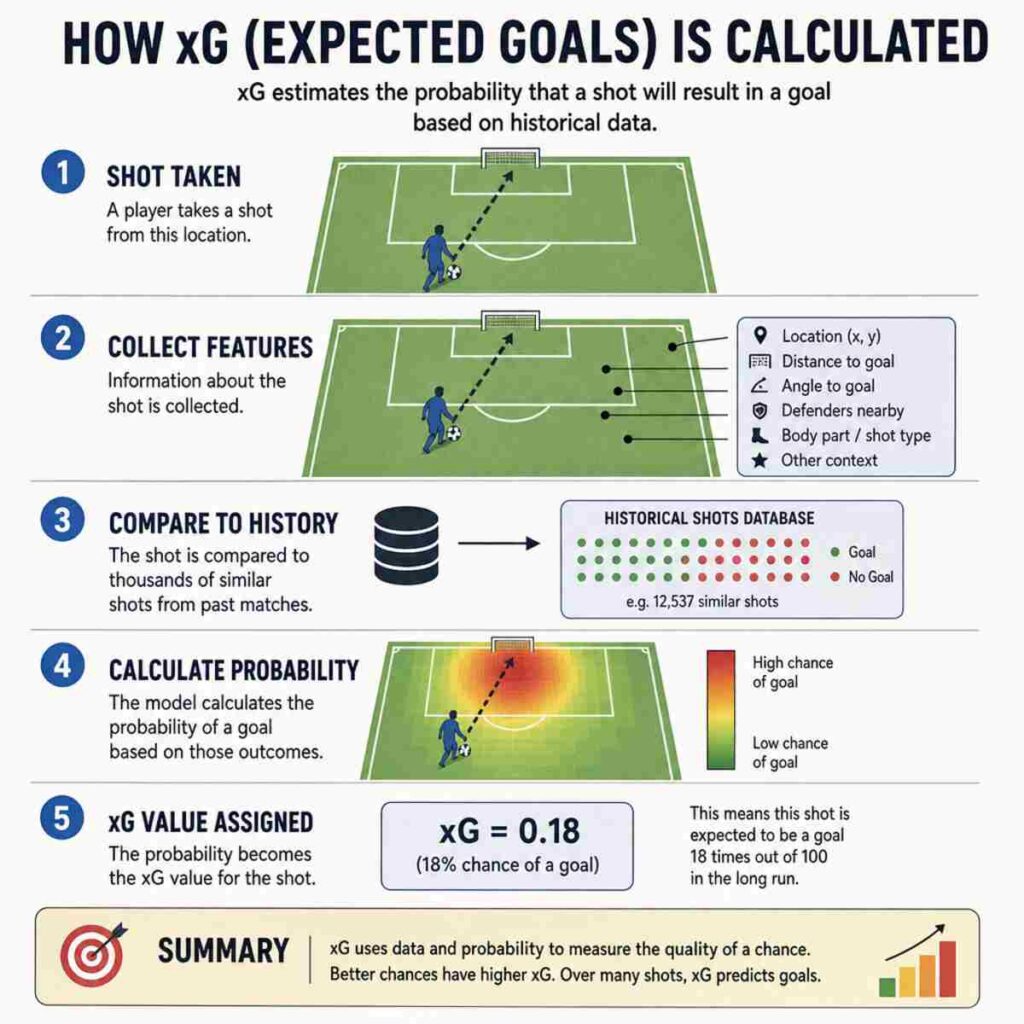
If you want to know how to analyze football matches for profit, mastering the concept of Expected Goals is non-negotiable. Understanding expected goals xG statistics is the key that unlocks a deeper comprehension of how a match actually played out, rather than just looking at the final score.
Expected Goals (xG) measures the quality of a goal-scoring opportunity. It assigns a probability (between 0.00 and 1.00) that a specific shot will result in a goal, based on historical data. Factors influencing xG include:
- Distance from the goal.
- Angle of the shot.
- Body part used (header vs. strong foot).
- Type of assist (through ball, cross, rebound).
- Defensive pressure (how many defenders are between the shooter and the goal).
Why is xG so important? Because football is a low-scoring game heavily influenced by variance and luck. A team might win a match 2-0 despite being dominated for 85 minutes. If Team A wins 2-0 but their xG was 0.5, while Team B failed to score despite an xG of 2.8, a mathematical model notes that Team B actually played much better.
When forecasting future matches, models rely on xG to identify teams that are “overperforming” (scoring more than their xG suggests, which is unsustainable) and teams that are “underperforming” (due for positive regression).
The Human Element vs. The Machine
As algorithms become more accessible, a fierce debate has emerged in the betting community regarding the best approach to forecasting.
Expert vs Computer Generated Betting Advice
When you look for Free Football Predictions online, you are generally consuming one of two things: human analysis or machine output. Understanding the nuances of expert vs computer generated betting advice will help you filter the noise.
Computer-Generated Advice:
- Pros: Completely objective, emotionless, and capable of processing millions of data points instantly. It excels at finding mathematical discrepancies in the odds.
- Cons: Machines struggle with unquantifiable context. A computer doesn’t know that a star striker is distracted by off-field contract disputes, or that a team has essentially given up on their manager.
Expert Advice:
- Pros: Human experts excel at contextualizing information. They utilize professional handicapper analysis techniques, such as understanding dressing room morale, tactical matchups (e.g., how a high-pressing team will exploit a slow defensive line), and weather nuances.
- Cons: Humans are inherently biased. An expert might overvalue a team because they are historically prestigious or let recent recency bias cloud their judgment.
The most profitable bettors do not choose one over the other; they combine them. They use computer-generated models to highlight potential opportunities, and then apply expert, contextual analysis to confirm if the model missed a human variable.
Essential Variables to Monitor
If you are combining human insight with statistical models, you must know where to look.
Reliable Sources for Soccer Team News and Lineups A model’s prediction is only as good as the players on the pitch. If Manchester City is playing, but Erling Haaland and Kevin De Bruyne are rested for an upcoming Champions League fixture, the model’s historical data becomes temporarily flawed. Therefore, utilizing reliable sources for soccer team news and lineups—such as verified club journalists on social media, official team press conferences, and specialized lineup apps—is vital. Always wait for confirmed starting XIs before finalizing your analysis.
Impact of Home Field Advantage on Match Outcomes Another crucial variable is the impact of home field advantage on match outcomes. While models automatically factor in home/away splits, the human analyst must dig deeper. Why is a specific stadium a fortress? Is it the hostile crowd, the dimensions of the pitch, the altitude (such as playing in La Paz, Bolivia), or a specific type of artificial turf? Furthermore, home advantage has statistically diminished slightly since the introduction of VAR (Video Assistant Referee), as referees are less swayed by intimidating home crowds. Adjusting your analysis for these nuances provides a massive edge.
Masterclass: The Search for Value
The biggest misconception among amateur bettors is that the goal of sports forecasting is simply to predict the winner of a match. This is fundamentally incorrect. The goal is to find value.
How to Identify Value Bets in Sports
Learning how to identify value bets in sports is the only proven mathematical route to long-term profitability. A value bet occurs when the probability of an outcome happening is greater than the probability implied by the bookmaker’s odds.
Here is the formula for calculating implied probability from decimal odds: Implied Probability = (1 / Decimal Odds) * 100
Example: Imagine Liverpool is playing Chelsea. The bookmaker offers odds of 2.00 for a Liverpool win. Implied Probability = (1 / 2.00) * 100 = 50% The bookmaker is stating that Liverpool has a 50% chance of winning.
Now, you run your mathematical football forecasting models, and based on xG data, recent form, and tactical matchups, your model concludes that Liverpool actually has a 60% chance of winning.
Because your calculated probability (60%) is higher than the bookmaker’s implied probability (50%), this is a Value Bet.
It does not matter if Liverpool ultimately loses the match. If you consistently place bets where the actual probability is higher than the implied probability, the mathematics of positive expected value (+EV) guarantee that you will make a profit over a large sample size of hundreds of bets.
Strategic Approaches to Football Markets
Once you understand how to spot value, you need to know which markets and strategies best suit your betting profile.
The Over/Under Market
Predicting the exact match winner in football can be incredibly frustrating due to the frequency of draws. This is why many sharp bettors pivot to the goals market.
Finding the best soccer prediction sites for over 2.5 goals is a common quest for bettors. The Over 2.5 goals market requires you to predict that three or more goals will be scored in total during the match, regardless of who scores them.
When analyzing this market, do not just look at “average goals scored.” Look at:
- Combined xG: Do both teams generate high xG and concede high xG?
- Pace of Play: Do both teams play a fast-paced, transition-heavy style?
- Game State: If Team A needs a win to avoid relegation, they cannot settle for a 0-0 draw. They will push forward, opening themselves up to counter-attacks, making Over 2.5 highly likely.
Accumulators (Parlays)
A popular, albeit risky, approach is the accumulator. A daily football accumulator strategy involves combining multiple selections into one single bet. The odds multiply, offering massive potential payouts from small stakes.
However, bookmakers love accumulators because the house edge also multiplies with every leg you add. To employ a smart accumulator strategy:
- Keep it short: Stick to doubles (2 selections) or trebles (3 selections).
- Correlated outcomes: Build “Bet Builders” or Same Game Parlays where outcomes complement each other (e.g., Team A to win + Team A’s main striker to score).
- Avoid massive odds: Don’t chase 100/1 accumulators expecting consistent wins. Use accumulators to combine two high-probability, low-odds events into one reasonable Evens (2.00) bet.
Expanding Beyond Soccer: American Football
While this guide heavily focuses on “the beautiful game,” the principles of forecasting models apply across the sporting spectrum. As the weekend approaches, many bettors actively look for free college football predictions this week.
The models used for NCAA American football share the same DNA as soccer models. They utilize historical data, player metrics, and situational spots. However, college football introduces unique variables:
- Massive Talent Discrepancies: Unlike the English Premier League, college football often features “buy games” where a powerhouse plays a massive underdog, leading to spreads of 40+ points.
- Transfer Portal and Opt-Outs: Player turnover in college football is unprecedented. Models must heavily weight recent roster changes, making reliable news sources even more critical.
- Pace and Possessions: Instead of xG, American football models look at “Yards Per Play” and “Points Per Possession” to identify value against the spread.
Whether you are looking at European soccer or college gridiron, the goal remains the same: beat the closing line by finding value.
Tools of the Trade: Maximizing Your Edge
Having the right knowledge is crucial, but having the right tools allows you to execute your strategy efficiently.
Comparing Betting Odds Across Different Bookmakers
If you were buying a car, you wouldn’t accept the first price you saw without checking other dealerships. The same applies to sports betting. Comparing betting odds across different bookmakers (a practice known as line shopping) is the easiest way to instantly increase your profit margin.
If Bookmaker A offers odds of 1.90 on a team to win, and Bookmaker B offers 2.05 on the exact same team, placing your bet with Bookmaker A is essentially throwing money away. Over the course of a season, grabbing that extra 0.15 of value on every bet is often the difference between a winning and losing bettor. Always maintain accounts with multiple reputable sportsbooks and utilize odds comparison websites.
Top Rated Soccer Tipster Apps
For those who do not have the time to build their own spreadsheets or run Python-based algorithms, there is a booming industry of prediction applications. The top rated soccer tipster apps aggregate data, track line movements, and provide actionable insights.
When evaluating these apps, look for:
- Transparency: Do they track and publish all their historical results, both wins and losses?
- Data visualization: Do they provide clear charts on xG, momentum, and head-to-head records?
- Community features: Are you able to see where the “sharp money” (professional bettors) is flowing?
Navigating the Pitfalls of Sports Betting
The internet is flooded with promises of easy wealth. To protect your hard-earned money, you must adopt a defensive mindset.
Protecting Yourself: How to Avoid Falling for Betting Scams
The demand for Free Football Predictions has unfortunately created a breeding ground for fraudsters. Learning how to avoid falling for betting scams is arguably more important than picking winners.
Watch out for these massive red flags:
- “Fixed Match” Claims: No one is selling genuine fixed match information on Instagram for $50. If someone actually had a fixed match, they would bet on it silently, not sell it online.
- Guaranteed Profits: Sports betting involves variance and luck. Anyone offering “100% guaranteed locks” is lying.
- Deleted Losses: Scam tipsters will post bets, and if they lose, they quickly delete the post to make their timeline look flawless. Only trust platforms that use third-party verification for their betting records.
- Pay-After-Win Schemes: A scammer will give Team A to half their mailing list and Team B to the other half. The half that wins gets asked for a “tip” or to buy a premium package. They are just flipping coins with your money.
Bankroll Management Tips for Sports Bettors
Even if you have the best mathematical models in the world and can accurately spot value bets, you will eventually go broke if you do not know how to manage your money. Implementing strict bankroll management tips for sports bettors is what separates the professionals from the amateurs.
Your “bankroll” is the total amount of money you have set aside specifically for betting. It should be money you can afford to lose without it affecting your daily life.
The Golden Rules of Bankroll Management:
- Unit Sizing: Never bet your entire bankroll on one game. A standard “unit” should be between 1% and 3% of your total bankroll. For example, if your bankroll is $1,000, your standard bet should be $10 to $30.
- Flat Betting: The most reliable strategy for beginners is flat betting—wagering the exact same amount (1 unit) on every single bet, regardless of how confident you feel. This protects you from emotional decision-making.
- The Kelly Criterion: For advanced bettors, the Kelly Criterion is a mathematical formula that dictates exactly how much of your bankroll you should wager based on the perceived edge (value) you have over the bookmaker. If your model shows a massive edge, the Kelly formula suggests a larger bet; if the edge is small, a smaller bet.
- Never Chase Losses: If you have a bad Saturday, do not double your bet sizes on Sunday to “win it back.” Stick to your unit sizing and trust your long-term mathematical edge. Variance happens.
Conclusion: Putting It All Together
The landscape of sports forecasting is vast, complex, and incredibly exciting. By shifting your mindset away from subjective guessing and toward objective data analysis, you elevate yourself above the average punter.
Remember that Free Football Predictions are a starting point, not a finish line. To truly succeed, you must embrace mathematical football forecasting models, deeply understand underlying metrics like xG statistics, and carefully blend expert vs computer generated betting advice.
Whether you are hunting for the best soccer prediction sites for over 2.5 goals, analyzing free college football predictions this week, or carefully comparing betting odds across different bookmakers, the core philosophy remains the same: seek value, manage your bankroll relentlessly, and avoid emotional decisions.
Sports betting is a marathon, not a sprint. By applying the professional handicapper analysis techniques and safeguards discussed in this guide, you will be well-equipped to navigate the unpredictable, thrilling world of football match forecasting for profit.